The Agogo oilfield was developed in two phases, with production from full field development achieved in August 2025.
The Agogo oilfield is located in Block 15/06 offshore Angola, operated by Azule Energy.
Azule Energy, an equal joint venture (JV) established by BP and Eni’s Angolan businesses, holds a 36.84% interest, while Sonangol P&P and Sinopec International hold 36.84% and 26.32%, respectively.
The first phase of the field began oil production in January 2020, nine months after its discovery in March 2019. Initial production stood at approximately 10,000 barrels of oil per day (bopd), reaching 20,000 barrels per day (bpd) during the following weeks.
The initial development phase enabled the JV partners to study the field and tap its complete potential by pursuing full field development through the addition of a new production hub.
The full field development was undertaken as part of the Agogo Integrated West Hub (IWH) project, which involved the development of the Agogo and Ndungu fields. The Agogo IWH project’s reserves are estimated to be approximately 450 million barrels (mbbl).
The final investment decision (FID) on the Agogo IWH project was taken in February 2023, and the project commenced production in August 2025.
Agogo oilfield discovery details
The Agogo offshore oilfield was discovered by drilling the Agogo-1 wildcat well, 20km west of the Ngoma floating production storage offloading (FPSO) vessel in the West Hub production area in Block 15/06 and approximately 180km offshore Angola.
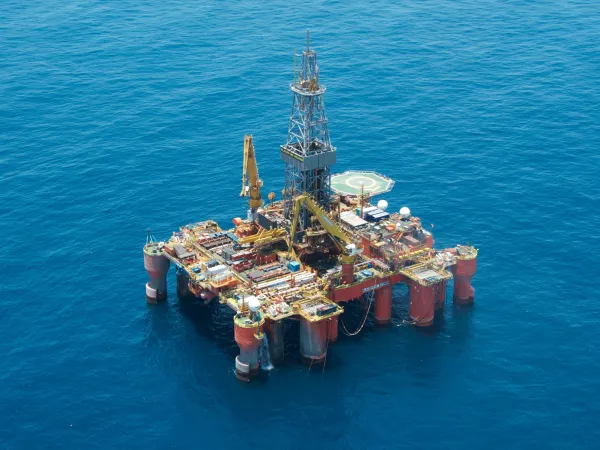
The well was drilled to a total vertical depth of 4,450m at a water depth of 1,636m using the Poseidon drill-ship. The well encountered a single oil column of approximately 203m with net pay of 120m of high-quality oil with 31-degrees API. The hydrocarbons are present in subsalt diapirs in Lower Miocene sandstones.
The mapping and drilling of the prospect were performed using Eni’s proprietary imaging technologies. Seismic imaging facilitated high-resolution, three-dimensional imaging of the field. Eni also used the subsea multiphase boosting system and gravity gradiedometry technology to better understand the nature of the rocks in the area.
The prospect was originally expected to hold roughly 450–650mbbl of light oil in place.
Appraisal details of the Agogo oilfield
The first appraisal well, Agogo-2, was drilled approximately 3km north-west of the Agogo-1 discovery well in July 2019.
The appraisal well was located roughly 23km from the Ngoma FPSO vessel. The well was drilled at a water depth of 1,700m to a total vertical depth of 3,949m to encounter 58m net pay of light oil with 31-degrees API in the Miocene and Oligocene era sandstones.
The highly deviated Agogo-2 appraisal well confirmed the presence of hydrocarbons to the north of the discovery well and below salt diapirs. The well indicated a production capacity of more than 15,000bopd.
A second appraisal well, Agogo-3, was drilled approximately 1.5km north-west of the Agogo-2 well, using the Libongos drill-ship. Agogo-3 was drilled to a total vertical depth of 4,321m in Miocene and Oligocene-age sandstones. It hit net pay of up to 120m of light oil with 31-degrees API in February 2020.
Agogo-3 was drilled as a highly deviated well that reached below the thick layer of salt and confirmed the interconnection of the reservoir in the subsalt area of the Agogo megastructure.
Agogo IWH development project details
The field development plan includes a total of 22 subsea wells, including 13 oil production wells and nine injection wells, which inject water and gas to enhance oil recovery.
Phase one development was undertaken through the existing Ngoma FPSO.
The start of production at the Agogo IWH was achieved through the Agogo FPSO, with a peak production of approximately 180,000bopd.
The subsea production system for the project is installed at a depth of 1,750m, and gathers the production from the wells and connects to 22 X-trees at four drill centres.

Subsea production units control all of the project’s subsea facilities including 150km of flowlines and umbilicals, 11 manifolds and 14 subsea distribution units.
The subsea production system is connected to the Agogo FPSO through 11 risers and two dynamic umbilicals.
Ngoma FPSO details
The Agogo oilfield was connected to the Ngoma FPSO to begin production from the field.
The FPSO features an oil processing capacity of 100,000bopd, a gas handling capacity of 115 million standard cubic feet per day and a water injection capacity of 120,000bpd.
Agogo FPSO
The Agogo FPSO is a spread-moored FPSO converted from a very large crude carrier. Featuring double balconies, the FPSO is more than 333m long, 60m wide, and has a moulded depth of 30.5m and a draught of 22.5m. It has a deadweight of 320,000t with a topside weight of 30,000t.
The vessel is equipped with 11 compressor trains, nine of which are centrifugal compressor trains for gas production, gas injection, gas lift and export, and the remaining two are screw-compressor trains for use as low-pressure compression units.
The FPSO incorporates a range of advanced technologies designed to reduce greenhouse gas emissions, including fully electrified topsides and marine systems, as well as the first offshore combined-cycle power generation unit of this scale. It also features a pilot carbon capture and storage unit installed on board.
The FPSO has a production capacity of 120,000bopd and storage capacity of 1.6mbbl. It is the first FPSO in Angola to have its operational carbon emissions fully offset.
Contractors involved in the Agogo oilfield
Aker Solutions, an energy solutions provider, was awarded a contract to supply subsea umbilicals for the field in February 2023. The scope of the contract included the engineering, manufacturing and supply of a 36km umbilical system comprising a dynamic and static subsea production control umbilical. The contract also covered provision for spares along with associated equipment and services.
Energy technology company Baker Hughes was selected to supply subsea equipment and services for the project in February 2023. The supply scope involved 23 standard subsea trees, 11 Aptara manifolds, SemStar5 fibre-optic controls and related systems.
Subsea7, a subsea engineering, construction and services provider, was chosen to provide the transport and installation services for approximately 98km of flexible pipes, 30km of umbilicals and associated subsea structures of the project in February 2023.
Energy technology provider TechnipFMC was awarded a contract to supply flexible pipes for the project in February 2023. The scope of the contract also includes the engineering, procurement and supply of jumpers, flowlines, risers and ancillary equipment.
Yinson Production, an energy infrastructure and technology provider, was awarded the contract to supply the new FPSO for the Agogo IWH project in February 2023. It is also responsible for the operation and maintenance of the FPSO under a 15-year contract, which includes an option to extend for five years.
Yinson subcontracted MAN Energy Solutions, a diesel and gas engine and machinery supplier, to supply 11 compressor trains for the FPSO in June 2023.
In March 2024, Blue Water won a logistics contract from Yinson Production, with its Floating Production Systems project team responsible for managing the shipment of the topside modules for the Agogo FPSO and coordinating the associated logistics activities. The scope covered the transport of 15 modules, including the largest unit weighing 3,211t.
PACC Offshore Services Holdings, a specialist in offshore marine solutions, was contracted to provide transoceanic tow service for the Agogo FPSO to Angola.
Saipem was awarded a contract to provide engineering, procurement, construction and installation services for rigid pipe-in-pipe flowlines with related subsea structures in April 2023. The company was previously contracted for the early phase one development of the Agogo oilfield in February 2020.
“From our platform to LinkedIn’s energy professionals – your announcements reach the entire sector’s network, not just our readers.”