


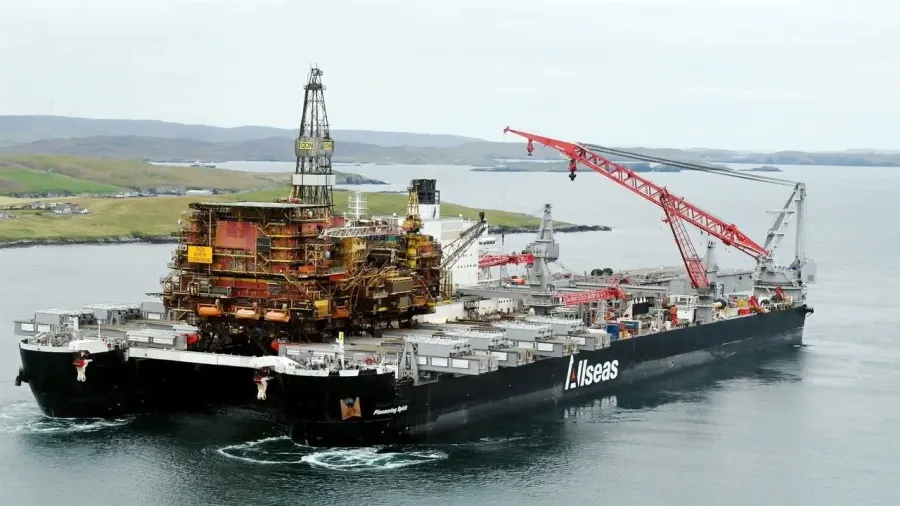
Allseas’ Pioneering Spirit Encapsulates the North Cormorant’s Dual Hull, Lifts Entire Topsides at Once, and Heads to Shetland, Concluding 42 Years of TAQA Production in the North Sea and Initiating a New Phase in a 120,000-Ton Steel Recovery Program.
The operation was announced by Allseas at the end of August and detailed by the specialized portal Offshore Energy. According to the company, the topside of the North Cormorant weighs 17,200 tons and was removed in a single lift, without cutting into blocks in the sea. The vessel then transported the entire structure to the Dales Voe dock in Lerwick, the capital of Shetland, where it will be dismantled and recycled.
The platform is located in the northern North Sea, about 500 kilometers northeast of Aberdeen, Scotland. According to Offshore Energy, the first oil was produced there in February 1982, and production ceased in June 2024. In the meantime, according to the Shetland press, the field delivered over 467 million barrels, a figure that underscores the sheer scale of the structure that is now becoming useful scrap.
How the Pioneering Spirit Lifts an Entire Platform
The secret lies in the vessel’s design. The Pioneering Spirit measures 382 meters in length and 124 meters in width, featuring an opening at the bow, a kind of gap between the two hulls, measuring 122 by 59 meters. In practical terms, the vessel approaches the platform in reverse until the structure is positioned within this opening, supported by horizontal beams that span the gap.
These beams are compensated for movement, meaning they rise and fall with the waves to ensure the topside does not experience impact during contact. Once everything is positioned, the system lifts the entire assembly at once, and the vessel retreats with the platform in tow. Twelve azimuth thrusters maintain precise positioning, according to Allseas’ technical specifications.
The vessel was built by Daewoo in South Korea, launched in January 2013, and began operating at sea in August 2016, at a cost of around €2.6 billion (about $2.7 billion). The original lifting capacity for topsides was 48,000 tons, but in 2019, Allseas announced an expansion to 60,000 tons, specifically aimed at North Sea removals. Additionally, the limit for jackets, which are the support structures fixed to the seabed, is 20,000 tons.
The vessel also serves as the largest pipeline installation vessel in the world, but it has set challenging records in decommissioning. In July 2024, it removed the topside of the Brent Charlie, weighing 31,000 tons, which is the world record for an offshore lift. Since 2016, according to Allseas, the vessel has brought more than 250,000 tons of decommissioned facilities from the North Sea ashore.


Four Months of Preparation for a Single Lifting Day
No one just shows up and lifts 17,200 tons on a whim. According to Allseas, the lifting of the North Cormorant was preceded by an offshore campaign lasting four months, during which teams performed structural reinforcements, installed lifting points, and separated conduits and risers, the pipes connecting the platform to the wells and subsea pipelines. Only after that could the vessel approach.
The operation marks the second removal of topside under a multi-year contract between Allseas and TAQA UK, the British arm of the Abu Dhabi energy company. The first was the Eider Alpha in 2025. In total, the program involves four platforms and over 120,000 tons of infrastructure to be removed from the sea, supported by the contractor Oceanic. There is an interesting coincidence in this timeline: exactly ten years earlier, in 2016, the Pioneering Spirit had performed its first commercial lift at the Yme platform.
The arrival in Shetland became a local event. The Lerwick Port Authority issued a notice to mariners, imposed a 500-meter exclusion zone around the vessel, and classified the work as the largest decommissioning project ever received by the port. The topside was landed in Dales Voe on Saturday, August 22, and the local media described it as a structure weighing about 16,000 tons, a number slightly lower than what Allseas reported, a difference likely reflecting different weighing criteria between operator and port.
What Happens to 17,200 Tons of Steel on Land
In Dales Voe, the dismantling will be handled by Brown and Mason Group, in partnership with Peterson Energies. Demolition on land is expected to take 12 to 14 months, with around 30 people involved, and the total project is estimated at 18 months. TAQA claims that at least 97% of the materials will be recycled, exceeding the 95% target the company set for the entire program.
Thus, this is where the single-lift model shows its economic logic. Cutting a platform into pieces at sea takes months of work at height, with cranes, unstable weather, and constant risk. Bringing everything intact to the dock transfers the complex part to a controlled environment where it is cheaper and safer to operate. Allseas precisely describes this reasoning on the official platform decommissioning page: reduce offshore exposure and move activities onshore.
I can’t help but wonder what a fleet like that would do in the Campos Basin, and we know that this question is not academic. Brazil has dozens of aging platforms entering the decommissioning phase, many of which were installed in the 1980s and 1990s. The costs associated with this work are among the most delicate discussions between Petrobras and the regulator. Therefore, for now, the country does not have anything resembling the Pioneering Spirit, and most removals still follow the traditional path of modular cutting or towing floating units.
Meanwhile, in the North Sea, the 2026 season has just begun. There are still two platforms left from the TAQA package, and Allseas has already released the video of the North Cormorant’s lift as a preview of what’s to come. In this way, each structure that comes out of the sea intact reinforces a pattern: the era of large fixed platforms from the 1980s is coming to an end, and dismantling them has become a business as significant as their installation.
“Join the companies that smart energy professionals follow – because when you’re featured on GEN, the industry pays attention.”