


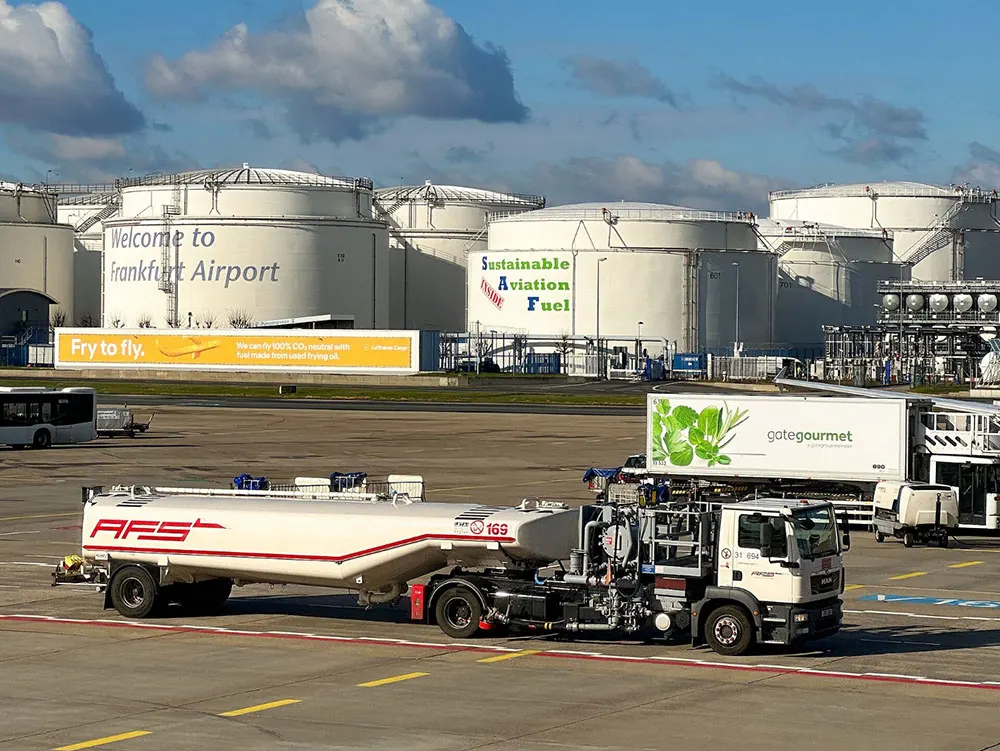
Regulation has made demand for sustainable aviation fuel a certainty, leading commodity traders to seek a route into a supply chain few of them built.
For commodity traders, sustainable aviation fuel (SAF) presents an unusual market. Demand is being created by regulation, but supplying it requires access to feedstocks, processing capacity and infrastructure that most trading companies do not own. The agreement between Dubai-headquartered trading house BGN Group and US-based XCF Global offers one example of how traders are entering the SAF supply chain, and what this reveals about the market’s structure.
In July 2026, following a memorandum of understanding signed in November 2025, BGN Group signed definitive agreements with XCF Global to access SAF without owning a production plant. Under the tolling arrangement, BGN supplies the feedstock and XCF processes it at its New Rise Reno facility in Nevada. The agreement targets production of 2,264 barrels a day of SAF and 481 barrels a day of renewable naphtha over an initial three years.
The arrangement illustrates one model through which a trading company can participate in SAF production without owning the processing facility. The model also leaves the trader exposed to the availability and economics of feedstock and to the performance of the production facility.
The approach is not without risk. Phillips 66 ended its offtake agreement with the New Rise facility on 1 May 2026. The company is one of a small number of established SAF producers, making its departure notable. Other trading companies are pursuing different forms of long-term access to production. In January 2026, Trafigura signed a six-year offtake agreement with Syzygy Plasmonics covering the output of the proposed NovaSAF-1 biogas plant in Uruguay, with first deliveries targeted for 2028, subject to financing.
The examples point to a broader question: what happens when regulation creates demand faster than physical supply can develop?
A small fuel with a large, growing pull
The demand for SAF is increasingly being determined by policy rather than voluntary purchasing decisions. According to the International Air Transport Association (IATA), SAF is expected to cover 0.8% of global jet fuel use in 2026, equivalent to about 2.4 million tonnes, with airlines expected to spend $4.3 billion on that volume. Global output rose from around 1 million tonnes in 2024 to 1.9 million tonnes in 2025 according to IATA estimates.
The European Union is creating a much larger market. Since 2025, its ReFuelEU Aviation rules have required fuel suppliers to ensure that 2% of fuel supplied at EU airports is SAF, rising to 6% in 2030, 20% in 2035 and 70% in 2050.
The UK introduced a similar obligation in 2025, initially requiring 2% of aviation fuel supplied in the country to be SAF, rising to 10% in 2030. Provisional Department for Transport data for 2025 show that suppliers delivered 333 million litres of SAF, equivalent to 2.26% of UK jet-fuel demand. The figure is above the initial 2% requirement, although the data remain provisional and the final 2025 dataset is due in November 2026.
The UK figures also illustrate the growing role of intermediaries in the market: the Department for Transport’s SAF statistics include data on trades of SAF certificates between suppliers and traders.
The underlying physical demand is also difficult to replace in the short term. Aviation has few alternatives to liquid fuels that can be deployed across the existing fleet at scale. IATA estimates that SAF could account for up to 65% of the emissions reductions the sector needs by 2050. For countries dependent on imported petroleum, locally sourced waste and other feedstocks could also provide an energy-security benefit.
The challenge is therefore no longer simply whether demand for SAF will exist. It is how quickly the physical supply chain can be built to meet it.
Why SAF costs so much
Cost remains one of the main barriers to scaling production. IATA estimates that SAF can cost around twice as much as conventional jet fuel in open markets and up to five times as much where mandates apply. S&P Global’s Platts priced SAF at $2,640 a tonne in northwest Europe on 11 March 2026, compared with $1,500 for conventional jet fuel.
The price difference also behaves differently from the conventional oil market. When crude prices rose sharply in early 2026, conventional jet fuel prices increased faster than SAF prices, narrowing the premium between the two. SAF prices depend more heavily on feedstock costs, production capacity and regulatory requirements.
Feedstock is therefore central to the economics of the emerging market. Much current SAF production uses hydroprocessed esters and fatty acids (HEFA), a process that converts used cooking oil, animal fats and other residues into aviation fuel. Collecting these materials is often fragmented, while significant supplies are located far from the markets where SAF is consumed.
UK data illustrate the geographic issue. The country’s 2025 SAF supply was overwhelmingly based on used cooking oil sourced from Asia, demonstrating how European mandates can create demand for feedstocks thousands of kilometres away from the aircraft using the finished fuel.
That raises a wider development question: who will supply the raw material, who will process it, and where will the economic value be captured?


Africa’s place in the emerging supply chain
Africa could become part of the answer, but its role is not predetermined.
The continent has potential sources of SAF feedstock, including used cooking oil, agricultural residues and other biomass resources. It also has a growing aviation market. But much of the infrastructure needed to collect, process and certify these materials remains limited.
There are early signs of production capacity developing on the continent. In South Africa, Sasol’s Natref refinery became the first crude-oil refinery in Africa to receive International Sustainability and Carbon Certification PLUS (ISCC+) product sustainability certification covering SAF and renewable diesel produced through the co-processing of used cooking oil and vegetable oil feedstocks.
In Kenya, Rubis Energy Kenya and Kenya Airways signed a memorandum of understanding in May 2026 to develop a modular SAF refinery in Nairobi. The proposed facility would use local feedstocks, including used cooking oil, residual animal fats and other vegetable oils, and is expected to have annual production capacity of 32,000 tonnes.
These projects point to a different possibility from simply exporting feedstocks to established refineries overseas. Processing closer to the source could retain more economic activity locally and potentially create demand for collection networks, logistics, technical skills and associated infrastructure.
But SAF is not a development opportunity by default. European mandates could also create a market in which African countries primarily export feedstocks to processing centres elsewhere, leaving much of the higher-value processing, industrial employment and technical expertise outside the continent.
The outcome will depend on the availability of infrastructure and finance, the economics of local processing, the ability to aggregate feedstocks at scale and whether domestic policy encourages investment beyond the extraction or collection of raw materials.
A concentrated production base
The challenge is compounded by the concentration of SAF production. According to ADI Analytics, five established producers — Neste, Diamond Green Diesel, Phillips 66, Calumet and World Energy — account for a large share of global production. Their facilities are concentrated mainly in the United States, Europe and Singapore.
That concentration matters as mandates expand. Regulation can create demand relatively quickly, but new SAF facilities can take years to finance, construct and bring into operation. The same applies to the collection systems and infrastructure needed to supply them with sustainable feedstocks.
Enforcement is another part of the equation. In June 2026, the European Commission opened infringement proceedings against 13 member states over their failure to establish penalties for breaches of the bloc’s aviation fuel rules by the end of 2024. The Commission issued letters of formal notice, the first stage of infringement proceedings.
The next technological challenge is e-SAF, or synthetic aviation fuel produced using renewable hydrogen and captured carbon dioxide. Its costs remain considerably higher than those of conventional jet fuel, while available production capacity is still far below the volumes implied by European and UK targets.
The gap between projected demand and physical capacity means that the SAF market will need more than additional mandates. It will require investment in production, feedstock collection, logistics, renewable energy and the infrastructure connecting all of them.
Who captures the value?
The financial cost of that expansion will ultimately be felt across the aviation system. IATA estimates that airlines paid a $2.9 billion premium for 1.9 million tonnes of SAF in 2025. Some airlines have introduced ticket surcharges to reflect part of the additional cost, while analysts differ considerably on the likely impact of mandates on future fuel prices.
But the more consequential question may be elsewhere in the supply chain.
SAF currently accounts for a small share of global jet fuel use, while European rules envisage a much larger role by 2050. Meeting those targets will require production capacity to expand beyond today’s concentrated group of producers and will increase demand for feedstocks around the world.
The experience of commodity traders such as BGN Group shows one-way companies can connect feedstocks, production and end users without owning every part of the physical infrastructure. For developing economies, however, a different question is emerging: whether participation in the SAF economy will remain concentrated in supplying raw materials, or whether countries can build the processing capacity and industrial ecosystems needed to capture more of the value.
As mandates rise, that question could become almost as important as how much SAF the world produces.
“When you share your news through GEN, you’re not just getting coverage – you’re getting endorsed by the energy sector’s most trusted voice.”