


By Rory MacKenzie, Business Development Manager, OSSO.
Decommissioning is widely recognised as a major and growing challenge, with operators under pressure to reduce both costs and emissions. However, while the North Sea is a key focus, these challenges are not confined offshore but extend across a vast network of onshore assets such as refineries and storage terminals, where complex waste streams, legacy contamination and ageing infrastructure create the same need to improve efficiency, manage costs and minimise environmental impact.
From trash to treasure
Significant waste streams are typically produced during cleaning and hydrocarbon removal and encompass a variety of materials from oil sludge to water contaminated with hydrocarbons and naturally occurring radioactive materials (NORM).
The standard approach to dealing with this contaminated fluid waste is ‘skipping and shipping’, where waste is shipped or tankered away and sent for further treatment, or even straight to incineration or landfill. However, this is costly, carbon-intensive and risks operators writing off significant values of hydrocarbons where the correct application of technology could salvage them.
Effectively cleaning infrastructure to remove all hydrocarbons often requires large volumes of water, for example to enable the pumping of oil sludge from storage tanks. The alternative to water is a long, laborious manual cleaning process that could greatly increase project timelines, costs, and risk to personnel.
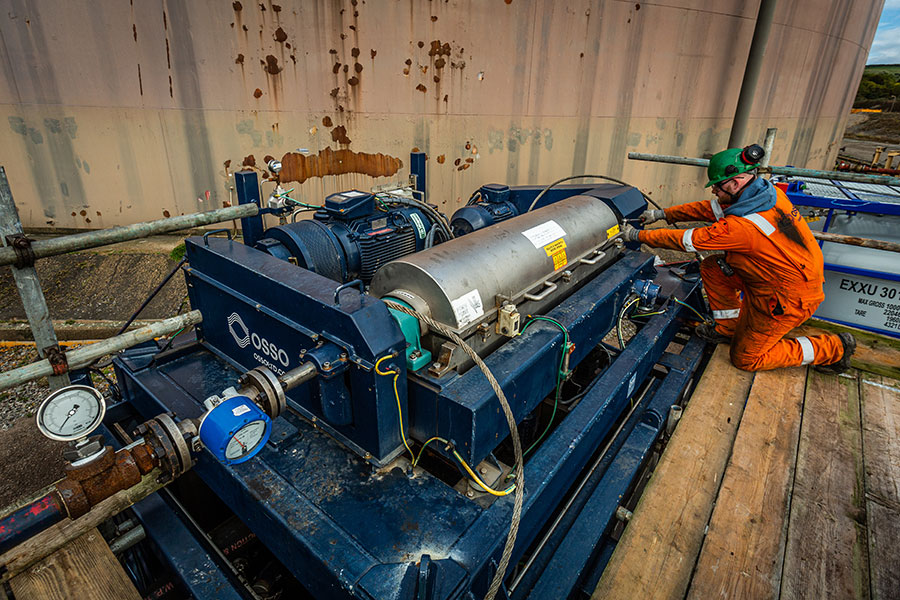
We recently worked on a project at an oil terminal in Scotland aimed at fully decommissioning an oil tank. Following a stringent pre-project process, we leveraged our decanter centrifuge and disc stack centrifuge technologies, to treat and separate over 4,540 cubic meters of waste sludge which had been pumped from the tank, including naturally occurring radioactive materials, water, solids, and recoverable oil.


This enabled the on-site disposal of over 3,060 cubic meters of water through an effluent treatment plant, saving a seven-figure sum in disposal costs and minimising carbon emissions from waste transportation. Crucially, it enabled the recovery of approximately 1,280 cubic meters of oil, valued at around £450,000. Consequently, the total savings and value recovered from the project are estimated to be in the millions.
Offshore optimisations
In offshore environments, those benefits become even more significant. With deck space, personnel numbers, lifting operations and vessel movements all tightly constrained, every additional skip or shipment to shore adds cost, complexity, risk and emissions. Effective separation at source can therefore play an important role in helping operators keep decommissioning programmes on schedule while reducing disposal volumes and environmental impact.
The oil-to-water ratio of wastewater discharged into the sea cannot exceed the regulatory limit of 30 parts per million (ppm). In many cases, the onboard technology can’t separate enough oil from the water to meet this standard, meaning that contaminated water must be transported back to shore for further processing or disposal.
While this is currently standard practice, the same separation technologies and principles can be applied to reduce cost and carbon emissions. For example, in a recent offshore project we were able to successfully treat approximately 8,000m³ of waste fluids and solids, around 79% of it below the 30ppm limit so that it could be safely discharged at source. This significantly reduced skip and ship requirements, resulting in notable cost and emissions savings for the operator.
Towards lower carbon and more cost-effective decommissioning
Ultimately, embracing separation technology could reduce the costs, risks and environmental impact of decommissioning across onshore and offshore environments. Treating waste at source would enable the industry to minimise the need for costly and carbon-intensive offsite transportation and disposal while also accelerating decommissioning and recovering valuable products for sale or re-use.
“Join the companies that smart energy professionals follow – because when you’re featured on GEN, the industry pays attention.”