About this report
The IEA Oil Market Report (OMR) is one of the world’s most authoritative and timely sources of data, forecasts and analysis on the global oil market – including detailed statistics and commentary on oil supply, demand, inventories, prices and refining activity, as well as oil trade for IEA and selected non-IEA countries.
Highlights
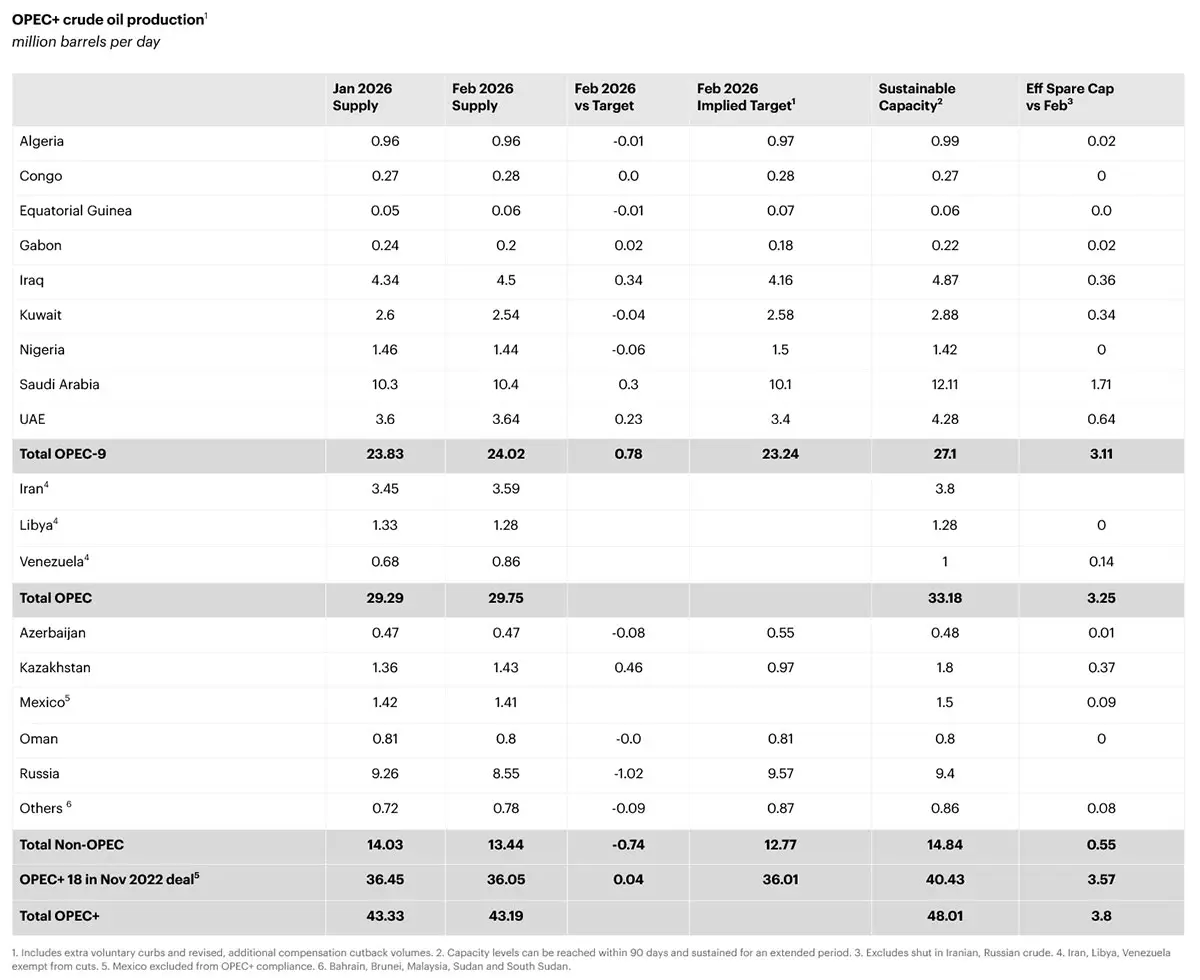
- The war in the Middle East is creating the largest supply disruption in the history of the global oil market. With crude and oil product flows through the Strait of Hormuz plunging from around 20 mb/d before the war to a trickle currently, limited capacity available to bypass the crucial waterway, and storage filling up, Gulf countries have cut total oil production by at least 10 mb/d. In the absence of a rapid resumption of shipping flows, supply losses are set to increase.
- Global oil supply is projected to plunge by 8 mb/d in March, with curtailments in the Middle East partly offset by higher output from non-OPEC+ producers, Kazakhstan and Russia following disruptions at the start of the year. While the extent of losses will depend on the duration of the conflict and disruptions to flows, we estimate global oil supply to rise by 1.1 mb/d in 2026 on average, with non-OPEC+ producers accounting for the entire increase.
- The conflict is also having a significant impact on global product markets, with export flows through the Strait at a near standstill. Gulf producers exported 3.3 mb/d of refined products and 1.5 mb/d of LPG in 2025. More than 3 mb/d of refining capacity in the region has already shut due to attacks and a lack of viable export outlets. Runs elsewhere will be increasingly limited due to feedstock availability.
- IEA Member countries unanimously agreed on 11 March to make 400 mb of oil from their emergency reserves available to the market to address disruptions stemming from the war in the Middle East. Global observed oil stocks were 8 210 mb in January, their highest level since February 2021. The OECD accounted for 50%, Chinese crude stocks 15%, oil on water 25%, with the remainder in other non-OECD countries.
- Widespread flight cancellations in the Middle East and large-scale disruptions to LPG supplies are expected to curb global oil demand by around 1 mb/d during March and April compared to previous estimates. Higher oil prices and a more precarious outlook for the global economy pose further risks to the forecast. Global oil consumption is now set to increase by 640 kb/d y-o-y in 2026 – down 210 kb/d from last month.
- Oil prices have gyrated wildly since the United States and Israel launched joint air strikes on Iran on 28 February. Disruptions to Middle Eastern supplies due to attacks on the region’s oil infrastructure and the cessation of tanker traffic through the Strait of Hormuz sent Brent futures soaring, trading within a whisker of $120/bbl. Prices subsequently eased with Brent around $92/bbl at the time of writing – up $20/bbl for the month.
Dire straits
The global oil market is contending with the ramifications of the war in the Middle East. Beyond the direct damage to energy infrastructure in the region, the crisis has led to a near halt in tanker movements through the Strait of Hormuz. With nearly 20 mb/d of crude and product exports currently disrupted and limited alternative options to bypass the world’s most critical oil transit chokepoint, producers and consumers globally are feeling the strain. Benchmark crude oil prices have surged by $20/bbl to $92/bbl since the outbreak of hostilities on 28 February, with even bigger increases across product markets.
With few ships currently able or willing to load cargoes at port, and domestic storage tanks filling up, producers in the region are reducing or shutting in production. While the situation on the ground is fast evolving and at times opaque, we estimate that crude production is currently being curtailed by at least 8 mb/d, with a further 2 mb/d of condensates and NGLs shut in. Major supply reductions are seen in Iraq, Qatar, Kuwait, the UAE and Saudi Arabia.
Disruptions are not limited to upstream production and exports, with several refineries and gas processing facilities shut down due to attacks or for safety concerns. The closure of the Strait is also forcing export-oriented refineries to cut runs or shut completely as product storage tanks top up, with more than 4 mb/d of refining capacity at risk. Gulf producers exported roughly 3.3 mb/d of refined products, and 1.5 mb/d of LPG in 2025. While additional throughputs in other regions are possible, feedstock availability will be a limiting factor. This has prompted some countries to implement product exports restrictions. Diesel and jet fuel markets look to be particularly vulnerable to an extended loss of Middle East production and exports, given limited flexibility elsewhere to increase output.
Meanwhile, the suspension of flights at major airports in the Middle East, with a knock-on effect on hubs elsewhere, has materially reduced global jet fuel demand. Plunging LPG and naphtha supplies are already forcing petrochemical plants to curb their production of polymers, aggravating the loss of Gulf petrochemical flows. LPG use in cooking and heating, especially in India and East Africa, is also at risk. More broadly, higher oil prices and a deteriorating economic outlook have begun to erode demand across the product spectrum. In this context, we have reduced the forecast for global oil demand growth in March and April by more than 1 mb/d on average – and for 2026 as a whole by 210 kb/d to 640 kb/d.
Consumer countries have significant amounts of oil in storage to bridge temporary supply losses. Global observed inventories of crude and products are currently assessed at more than 8.2 billion barrels, the highest level since February 2021. Roughly half of these are held in OECD countries, of which 1.25 billion barrels by governments for emergency purposes, with a further 600 million barrels of industry stocks held under government obligation.
IEA member countries agreed on 11 March to make available an unprecedented 400 mb of oil from their emergency reserves available to the market to mitigate the negative impact on economies from the supply disruptions. These additional oil supplies will be offered to the market by implementing emergency stock draws or other measures, according to national circumstances.
The co-ordinated emergency stock release provides a significant and welcome buffer, but in the absence of a swift resolution to the conflict, it remains a stop-gap measure. The ultimate impact on oil and gas markets and the broader economy from the conflict will depend not only on the intensity of military attacks and any damage to energy assets, but also, crucially, on the duration of disruptions to shipping through the Strait of Hormuz. Adequate insurance mechanisms and physical protection for shipping are key to the resumption of flows, which is of paramount importance for the oil market.
“From our platform to LinkedIn’s energy professionals – your announcements reach the entire sector’s network, not just our readers.”