


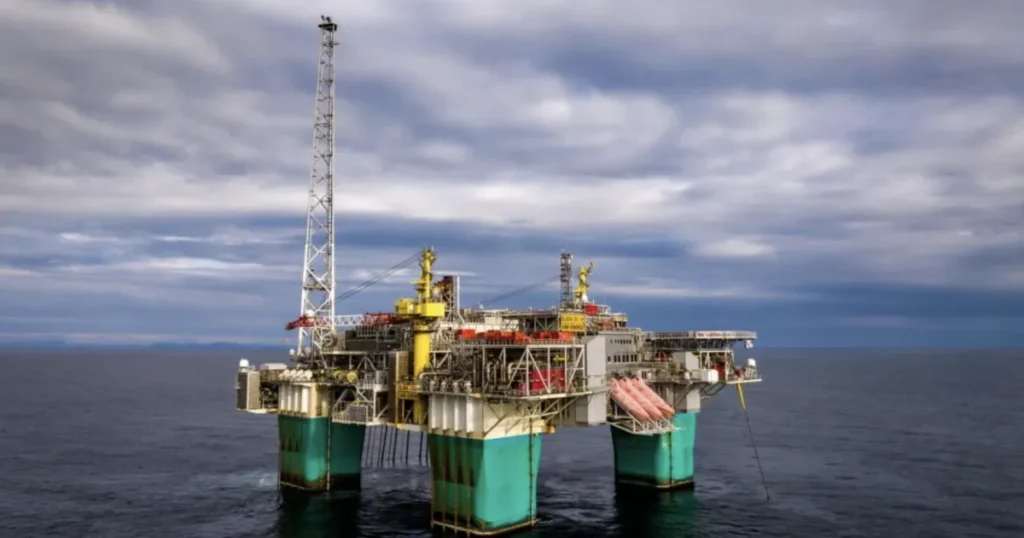
The co-owners of the Kjøttkake oil and gas discovery in the Norwegian North Sea have taken a final investment decision on a roughly $900 million development, with the partners claiming it will be the fastest field development ever delivered on the Norwegian Continental Shelf. The project has also been given a new name, Lyra.
Aker BP chief executive Kalle Bakken confirmed the decision on the company’s third quarter earnings call. He said the plan for development and operation will be submitted shortly and joked that this would probably be the last time he talked about Kjøttkake, with the new name being easier for an English speaking audience.
The field was discovered by DNO in the first quarter of 2025 and is estimated to hold 37 million barrels of oil equivalent of recoverable resources. DNO holds a 40 percent interest. The development will be a three well subsea completion tied back to the Gjøa platform, with gross production reaching around 20,000 barrels of oil equivalent per day at plateau. First oil is scheduled for the first half of 2028, only three years after the discovery.


The operating arrangement is unusual. DNO drilled the exploration well and sidetracked it immediately to appraise the find, then handed operatorship to Aker BP for the development phase so the project could draw on Aker BP’s supplier relationships, order book and standardised approach. Operatorship will revert to DNO after first oil. DNO executive chairman Bijan Mossavar-Rahmani has said the aim is to show how discoveries can be put on production in record time and to speed up monetisation of DNO’s own inventory of undeveloped finds. DNO managing director Chris Spencer told analysts that capital cost is expected to be in the range of $20 to $25 per barrel of oil equivalent.
Lyra becomes the sixth project DNO has under development and the fifth tie-back to the Gjøa hub. The company’s recently completed projects, Maria Revit, Andvare, Verdande, Symra and Dvalin North, hold 33 million barrels of oil equivalent of net proved and probable reserves between them. DNO’s Gjøa area output averaged 17,000 barrels of oil equivalent per day in the third quarter, and the group is targeting North Sea production of 100,000 barrels of oil equivalent per day by 2030.
The decision lands alongside a second piece of good news for DNO this week. An appraisal well at the Afrodite gas condensate discovery more than doubled estimated recoverable resources to between 77 and 180 million barrels of oil equivalent, with the most likely development being a 30 kilometre tie-back to the Kvitebjørn hub.
“When you share your news through GEN, you’re not just getting coverage – you’re getting endorsed by the energy sector’s most trusted voice.”