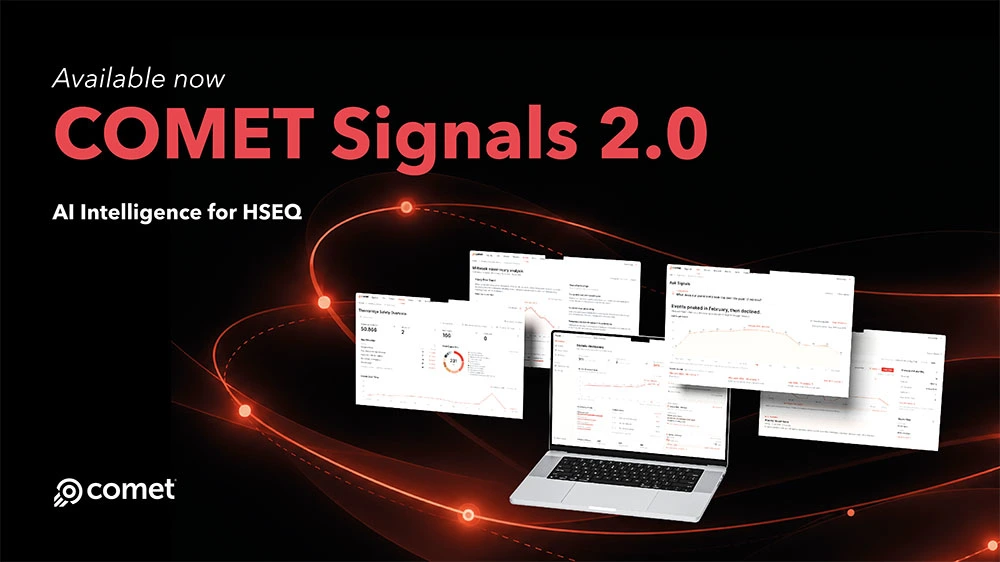
New AI intelligence layer connects existing HSEQ and operational data across multiple systems to deliver verified answers, accountable actions and measurable results, without system migration.
Aberdeen, Scotland, 12 November 2026.
In high-risk industries, every incident, audit and inspection is recorded somewhere. Asking a question of all of it is where the process breaks down: what is changing across the operation, or whether the last intervention worked, takes weeks of manual effort to answer, or goes unanswered. COMET Signals 2.0, already available from COMET, the incident investigation, root cause analysis and HSEQ technology company, is built to close that gap. It is an AI intelligence layer that sits above the HSEQ systems operators run today.
COMET Signals 2.0 continuously analyses an organisation’s incident, audit, inspection, quality, environmental and risk records, even when each sits in a different system. It classifies every record against the organisation’s own taxonomy and brings them together into a single body of evidence that teams can question in plain language, explore, act on and measure. It requires no migration and no change to how frontline teams record their work.
The platform is built around four connected steps. Ask returns answers checked against the organisation’s own records, with the reasoning and source events attached. Discover surfaces rising patterns across every site and register. Decision Boards hold the evidence, the conclusion and the agreed actions in one place, each action with an owner, a date and a cost. Track then measures whether the indicator moved once the work was done.
COMET Signals 2.0 also drafts risk assessments, toolbox talks, trend reports and board packs from the same checked evidence, ready for teams to review and approve.
“Most organisations in high-risk industries have spent years collecting HSEQ data, and the signal that could prevent the next failure is already in it,” said Mark Rushton, Chief Executive Officer of COMET. “The hard question has always been what to do with it, and whether what you did made a difference. Most AI stops at the answer. Signals 2.0 carries on. It connects the question to the evidence, the decision to an owned action, and the action to proof that the number moved, so leadership can show a board or a regulator what they found, what they did and whether it worked.”
Where most AI tools produce an answer and leave the reader to decide whether to believe it, COMET Signals 2.0 treats confidence as a feature of the product. The platform keeps three signals separate: the quality of the underlying data, the confidence in how records were classified, and the reliability of the answer itself. A verifier agent checks every quantitative claim against the evidence before it reaches the screen. When the data cannot support an answer, Signals abstains and highlights the knowledge gap rather than generating an answer.

“AI in HSEQ has to clear a higher bar than AI in most other domains, because its outputs will be read by investigators, auditors and regulators,” said Arrash Nekonam, Chief Technology Officer of COMET. “Signals 2.0 is transparent by design. It checks the quality of your data as it comes in, tells you how confident it is in every answer, and traces every number back to the query behind it. When the evidence is thin, it says so. You make the call, we make sure you’re making it on the best evidence available.”
COMET Signals 2.0 was designed from the outset for organisations whose records hold sensitive operational and personal data, with privacy and security built into its architecture. Names and other personal details are removed the moment a record comes in, before anyone analyses or searches it. Each organisation’s data is kept completely separate from every other customer’s, and organisations can control the encryption keys that protect it.
The platform is Azure-native, DPIA assessed and aligned to ISO 42001, the international standard for AI management systems. Analytical reasoning runs server-side, every number traces back to a named query, every prompt is versioned and a full audit trail records activity on the platform, so a security team, an auditor or a regulator can see exactly how an answer was produced.
COMET Signals 2.0 also adapts to the way each organisation works. Its categories, terminology, dashboards and specialist tools can be set up and changed by the organisation’s own team the same day, with no software developers involved. If an organisation changes how it sorts its risks, Signals can re-sort years of past records to match, so the insight keeps pace as the organisation changes.
COMET Signals 2.0 follows the release of COMET AI Assistant in April 2026, the first AI capability built specifically for incident investigation and root cause analysis, and October’s Verdantix Green Quadrant: EHS Software (2026), which named COMET’s AI data analytics collaboration with Intelex as a notable example of a new generation of domain-specific AI partnerships in EHS.
COMET Signals 2.0 is available now, with implementation measured in days rather than months. An explainer and further information are available at www.cometanalysis.com/software/ai-data-analytics
“When you share your news through GEN, you’re not just getting coverage – you’re getting endorsed by the energy sector’s most trusted voice.”