



Introduction & Market Context
BW Offshore presented its second-quarter 2026 results on August 24, revealing a mixed performance that sent shares down 11% to $40.35 in premarket trading. While the floating production specialist reported improved EBITDA and maintained its dividend, investors focused on a sharp reduction in full-year guidance and a $125 million non-cash impairment tied to delays at its flagship BW Opal project.
The company’s stock fell from the previous close of $45.40, moving closer to the lower end of its 52-week range of $33.90 to $54, as the market weighed operational progress against a revised completion timeline that pushes BW Opal’s practical completion to the second quarter of 2027 from the fourth quarter of 2026.
Quarterly Performance Highlights
BW Offshore reported second-quarter EBITDA of $63 million, up from $48 million in the first quarter and $57 million in the year-ago period. The improvement reflected stronger commercial uptime across the fleet and initial revenue recognition from BW Opal following its May 3 production restart.
As shown in the following summary of key quarterly metrics:
The quarter’s headline net loss of $102 million was driven entirely by the non-cash impairment on BW Opal. Excluding this charge, underlying net profit reached $23 million, maintaining stability with the first quarter’s $23.4 million result. First-half EBITDA totaled $110 million.
CEO Marco Beenen and CFO Ståle Andreassen emphasized that the impairment stems from vendor-related technical issues identified during commissioning rather than fundamental design flaws. The charge reflects additional costs and extended borrowing costs associated with the revised completion timeline, but management noted it could be reversible under IFRS if project assumptions improve.
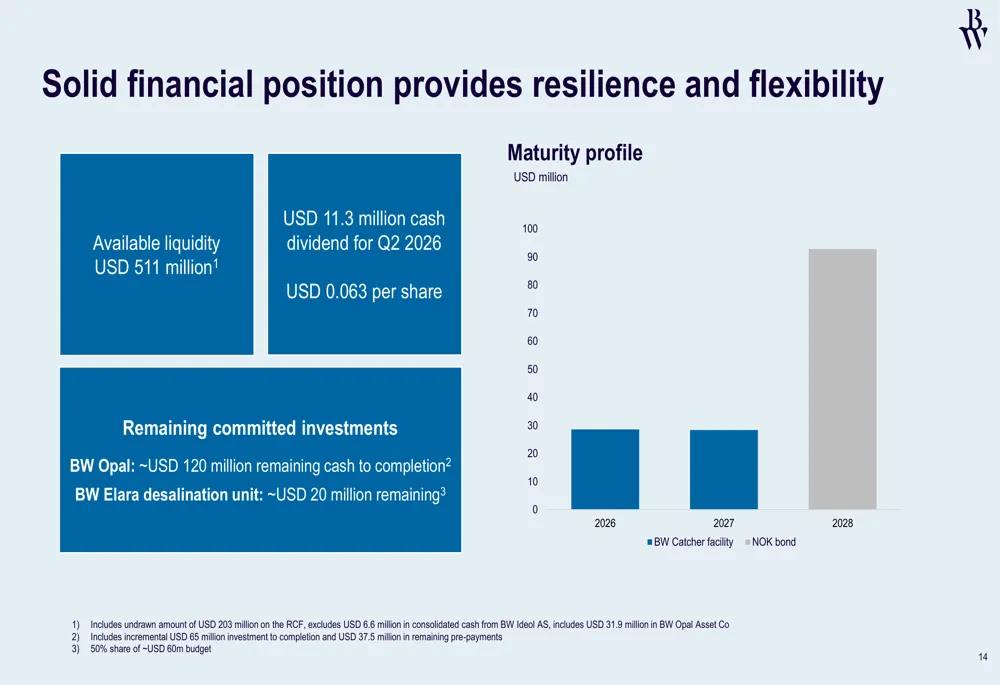
The company maintained its quarterly cash dividend at $11.3 million, or $0.063 per share, consistent with its seven-year track record of dividend payments and current yield of approximately 7.59%.
Detailed Financial Analysis
The quarter’s financial performance showed strength in core operations offset by project-specific challenges. Operating revenues rose to $163.1 million from $130.2 million in the first quarter, driven by BW Opal’s contribution following its restart.
The following income statement breakdown illustrates the quarter’s financial structure:
Operating expenses increased to $100.6 million from $82.3 million, reflecting higher activity levels. The $125.3 million impairment charge on BW Opal dominated the bottom line, though management stressed this is a non-cash item with no impact on liquidity or debt service capacity.
BW Offshore revised its full-year 2026 EBITDA guidance to $250-280 million from $310-340 million, representing an 18% reduction at the midpoint. The company attributed approximately $50 million of the cut to the BW Opal schedule change and roughly $10 million to increased tender activity and ADMEX operations. Importantly, management noted the net cash impact from this revision is limited to approximately $10 million.
The following chart demonstrates the quarterly EBITDA trend and revised outlook:
The company expects BW Opal to generate incremental revenue ahead of contract commencement, with post-practical completion annual EBITDA projected at $265-275 million once the 15-year fixed contract period begins in the second quarter of 2027.
BW Opal: Production Status and Path Forward
BW Opal emerged as the quarter’s central focus, with the FPSO now producing at approximately 85% of nameplate capacity following its May restart. The unit delivered 97-98% of nominated gas volumes during the quarter and loaded its first condensate cargo of roughly 300,000 barrels in July.
The following image shows the vessel during cargo operations:
Despite stable production, commissioning work revealed vendor-related technical issues that require additional time to resolve. Close collaboration with client Santos has shifted the practical completion date to the second quarter of 2027, delaying the start of the 15-year firm contract period that includes an additional 10 years of options extending potentially to 2052.
An incremental investment of approximately $65 million is required for completion, though management emphasized this will be largely offset by additional revenue generated during the extended commissioning period. Remaining committed investments include approximately $120 million in cash to completion for BW Opal, incorporating the $65 million incremental amount and $37.5 million in remaining pre-payments.
The delay stems from bottlenecking issues discovered during ramp-up, including membrane replacement work, methanol tank cleaning, and steam system repairs. Management clarified that no full production shutdown is required; instead, membrane banks will be replaced sequentially, reducing production by approximately 50% for a couple of weeks during each campaign.
Operational Excellence Across Core Fleet
Beyond BW Opal, BW Offshore’s contracted fleet delivered exceptional performance in the second quarter. The company achieved 100% weighted average fleet uptime in both the first and second quarters of 2026, maintaining the strong performance trend from the fourth quarter of 2025.
Fleet performance metrics demonstrate consistent operational excellence:
BW Adolo continued producing above 26,300 barrels per day in the second quarter under its contract with BW Energy in Gabon, operating on a production tariff structure of $1.50 per barrel up to 20,000 barrels daily and $3.00 per barrel beyond that threshold. The unit’s contract runs through 2028 with options extending to 2038, and includes a put/call option in 2028 following operations and maintenance handover to BW Energy in 2025.
BW Catcher maintained production of approximately 19,928 barrels per day under its contract with Harbour Energy in the UK North Sea. The unit operates under a contract extending to 2030, with charter rates that stepped up in February 2026. From January 2028, base charter hire will step down approximately 25%, offset by a production-linked key performance indicator that activates at 25% of production revenue above 6,000 barrels daily, capped at $200,000 per day.
Pioneer continues under a five-year operations and maintenance contract with Murphy Oil in the U.S. Gulf of Mexico, with the service fee structure increasing in tiers. Murphy Oil plans additional drilling in the second half of 2026, which could boost production from current levels.
Strong Financial Position and Contract Backlog
BW Offshore maintained robust financial health despite the BW Opal impairment, ending the quarter with $511 million in available liquidity. This includes $203 million undrawn on the company’s revolving credit facility, $257 million in cash and cash equivalents, and $31.9 million in BW Opal Asset Co.


The company’s contract portfolio provides substantial visibility into future cash generation:
The operating cash flow backlog totals approximately $2.2 billion, with 97% representing firm contracts. The backlog breakdown shows 7% expected in 2026, 13% in 2027, 13% in 2028, 11% in 2029, and 55% beyond 2030, reflecting the long-term nature of FPSO contracts.
Cash flow dynamics in the second quarter reflected increased investment activity alongside stable operations:
The waterfall chart shows cash declining from $340 million at March 31 to $257 million at June 30, driven by $38 million in BW Opal and other project investments, $27 million in net funding to the Barossa joint venture, $25 million invested in money market funds, and $15 million in net debt reduction. Operating cash flow of $42 million remained stable quarter-over-quarter.
BW Offshore’s balance sheet strength is further evidenced by its net cash position and conservative leverage:
The company reported a net cash position of $101 million (excluding lease liabilities and the BW Opal finance liability) with a leverage ratio of 0.0x throughout the past two years. The equity ratio stood at 28.3% at quarter-end, comfortably above the 25% covenant minimum, though down from 31.4% in the first quarter due to the impairment charge.
The debt maturity profile shows manageable near-term obligations:

Strategic Positioning in Growing FPSO Market
BW Offshore’s presentation highlighted a promising industry outlook, with 70-plus likely FPSO awards expected between 2026 and 2030. The company positioned itself to capture opportunities through selective bidding focused on projects that meet strict return requirements.
The global FPSO opportunity set by region and contracting type illustrates market breadth:
Brazil leads with 15 lease-based opportunities, followed by Southeast Asia with 14 total prospects (9 lease, 4 lease/own, 1 own) and Africa with 16 combined opportunities. The company’s competitive offering emphasizes gas FPSO expertise, harsh-environment solutions, newbuild rapid framework hull capabilities, redeployment and conversion track record, and comprehensive operational experience.
BW Offshore’s strategic approach focuses on pursuing 2-4 prospects annually with an ambition to win one project every other year. Current tender targets for 2026 include Buzios 12, KAN, and Zama projects.
The company’s global prospect pipeline is mapped across key regions:
Bay du Nord represents a significant near-term opportunity, with the FEED phase ongoing through year-end 2026. Equinor’s acquisition of BP’s interest, increasing its ownership to 100%, is viewed positively by management as it consolidates decision-making with a single committed operator. First long-lead items have been ordered, and BW Offshore expects a final investment decision and potential contract award in early 2027. The company plans to open an official office in St. John’s, Newfoundland and Labrador to support the project.
Beyond traditional FPSO operations, BW Offshore is developing floating transition solutions across three categories:
The floating offshore wind segment, operated through 68%-owned BW Ideol, achieved full capacity for the 30 MW EolMed project and received onshore consent for the 960 MW Buchan project. Commercial viability is projected within 3-5 years.
BW Elara, a 50/50 joint venture with BW Group focused on floating desalination, appointed Matthew White as CEO and is progressing delivery of its first barge, targeting completion and transport to site in early 2027. This solution has a commercial viability timeframe of less than two years.
The company is also exploring opportunities in FLNG and floating gas-to-power with carbon capture and storage, with commercial viability expected within 0-5 years depending on specific applications.
Forward-Looking Statements and Outlook
BW Offshore outlined several key objectives for the coming quarters:
The company’s near-term priorities include progressing BW Opal to practical completion in the second quarter of 2027, completing FEED for Bay du Nord in 2026, targeting one FPSO final investment decision within 12 months, bringing the first floating desalination unit to market, and maintaining an attractive shareholder return program.
The strategic review process remains ongoing, though the revised BW Opal timeline has extended its expected conclusion. Management reiterated the company’s commitment to its minimum annual dividend of $0.25 per share, though the impairment eliminates the possibility of a fourth-quarter 2026 dividend top-up that might otherwise have been considered.
Comprehensive key financial metrics demonstrate the company’s overall position:
At quarter-end, BW Offshore reported an EBITDA margin of 38.3%, return on equity of -3.0% (impacted by the impairment), and return on capital employed of 3.4%. The company’s market capitalization stood at approximately $802 million based on a share price of NOK 43.8.
The presentation emphasized BW Offshore’s dual focus on executing existing projects while positioning for growth in an expanding market. With BW Opal expected to contribute $265-275 million in annual EBITDA once operational, Bay du Nord advancing toward a 2027 decision, and a robust pipeline of global opportunities, the company maintains its long-term growth trajectory despite near-term execution challenges.
Management’s message balanced acknowledgment of the BW Opal setback with confidence in the company’s operational capabilities, financial resilience, and strategic positioning in a market expected to see significant FPSO contracting activity through the end of the decade.
“When you share your news through GEN, you’re not just getting coverage – you’re getting endorsed by the energy sector’s most trusted voice.”