By Harold Floyd, Elite Force Safety, in partnership with Mechanix Wear
Harold Floyd does not worry most about the worker on their first week. He worries about the one who stopped thinking about the risk years ago. In decommissioning environments, where mechanical handling incidents dominate the incident record and the hazard profile shifts daily, familiarity is not protection. It is the problem.
Across fifteen years of recorded decommissioning incidents compiled by IMCA, safe mechanical lifting was the most frequently broken Life-Saving Rule (IMCA SF 06/25). In Harold’s experience, the work that keeps hands busiest is the work where attention drifts first.
Experience creates blind spots
is not routine operations. Structures that have been stressed, corroded and patched for decades do not behave predictably. A worker’s instincts, built on years of operational experience, are calibrated to a different version of the same asset. The hazard profile on day one of a decommission is not the same as day thirty.
Yet the workforce arriving on site rarely arrives without assumptions. They know the equipment. They know the tasks. What the environment has changed, they often have not accounted for.
Harold knows this the moment he walks on site. “The first thing I look at is the PPE people are actually wearing — and how they are wearing it. One glove on. Eye protection sitting on top of the head. Hi-vis jacket undone. These are not small things. They tell you immediately that personal protective equipment has stopped being personal. It has become something people carry, not something they use.”
Where hands are most at risk
The tasks that define decommissioning — cutting through aged pipework, handling degraded structural components, working in confined and unpredictable spaces — create a hand injury profile that demands more than standard-issue protection. The hazard is not constant. It shifts with every task, every structure, every day of a project.
That variability is what makes glove selection a risk decision, not a procurement one.
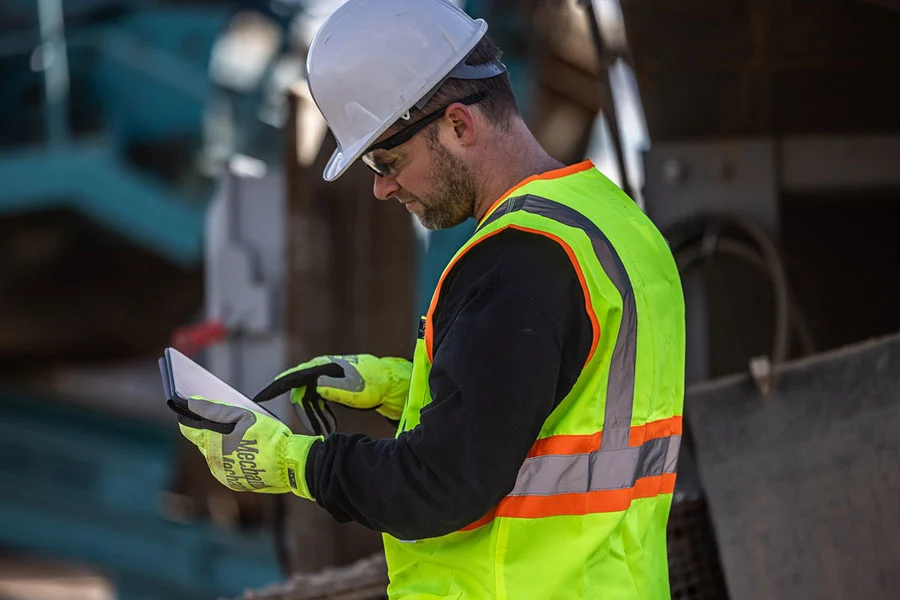
“As a manual handling specialist, the first thing I look at when observing people working is what they have on their hands,” says Harold. “In decommissioning there are so many different items to handle, and when you are breaking or cutting there is always a finger entrapment hazard. You need resistance, abrasion protection, cut protection — and if you can get crush and impact protection as well, that is a significant bonus. The difficulty is finding a single glove that covers all of that. The M-Pact Max Cut F9-360 is my number one choice because it does.”
Training that changes behaviour, not just awareness
Knowing the risk exists is not the same as acting on it. Harold’s approach is built on that distinction. Generic instruction tells workers what the rules are. It rarely changes what they do in the moment the glove comes off for a quick adjustment on a task they have performed a hundred times before.
The military veterans who deliver Elite Force Safety training bring field credibility with workers who have heard the safety briefing before and stopped listening. Face-to-face, site-specific, built around the actual tasks a workforce performs. The goal is not compliance on the day of the training. It is behaviour that holds on day thirty of a decommission, when the pressure is high, the timeline is short, and the worker has done this job more times than they can count.
The military veterans who deliver Elite Force Safety training bring field credibility with workers who have heard the safety briefing before and stopped listening. Face-to-face, site-specific, built around the actual tasks a workforce performs. The goal is not compliance on the day of the training. It is behaviour that holds on day thirty of a decommission, when the pressure is high, the timeline is short, and the worker has done this job more times than they can count.
“The only way to shift behaviour in an experienced workforce is to actually engage with them — ask what works and what does not,” says Harold. “With hand protection specifically, that means running trials with different gloves and making sure people are wearing the right size. Far too often workers are handed one-size-fits-all and expected to get on with it. When PPE does not fit, people do not respect it. You see it immediately — gloves thrown away at the end of a shift, equipment not looked after. Listening to what workers tell you and acting on it is what changes things. Doing the same thing day in, day out and calling it safety does not.”
The last job is not the lowest risk job
Decommissioning projects run on compressed timelines and shrinking budgets. Safety decisions made at the start rarely get revisited as conditions change. The workers who carry the most risk into a decommissioning project are often the ones with the most experience — not because they are careless, but because their confidence was built in a different environment.
Changing that belief is Harold Floyd’s job. The right tools need to be there when it does.
Harold Floyd is the founder of Elite Force Safety, delivering bespoke face-to-face health and safety training led by military veterans. Mechanix Wear designs and manufactures performance hand protection for industrial, energy and utility applications globally.
Mechanix Wear recommends
Task-matched hand protection for decommissioning environments:
Everyday decommissioning tasks The Original® / FastFit® / M-Pact® General mechanical handling, maintenance and site work requiring dexterity, comfort and sustained compliance across a full shift.
High-risk mechanical handling M-Pact® Max Cut F9-360 Harold’s personal choice for cutting, grinding, structural removal and pipeline handling. 360° ArmorCore™ 9 cut protection exceeding ANSI A9 and EN Level F. D3O® palm padding for impact and vibration dissipation. HiRoller™ rollover fingertips for durability in the highest-wear areas.
Sources
IMCA Safety Flash SF 06/25. Incidents occurring during decommissioning. Published 3 April 2025.
Health and Safety Executive (2025). RIDSITE: Work-related injuries reported under RIDDOR by site of injury. Published 20 November 2025.
“Your company news doesn’t just get published – it’s seen by the decision makers who matter.”