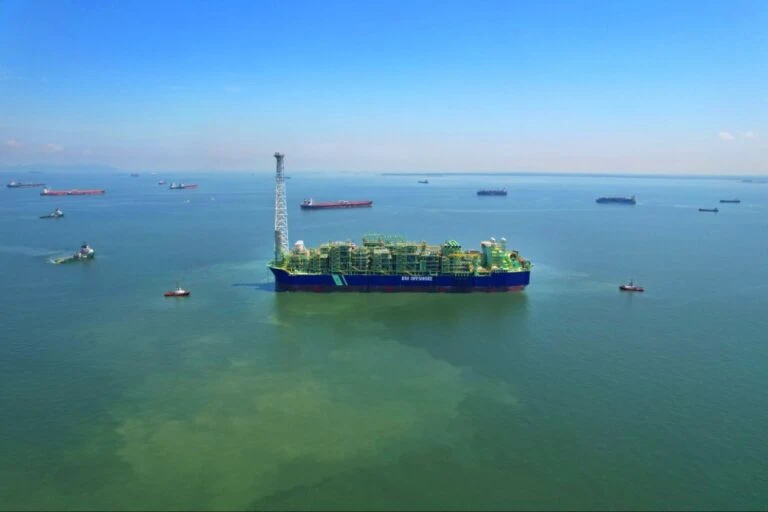
Santos is battling blocked heat exchangers, failed subsea valves, and faulty safety doors 285km north of Darwin so it can reap the reward of high gas prices in Asia.
The restart of Santos’ flagship Barossa gas export project encountered an array of problems in the same week that chief executive Kevin Gallagher received $5 million in company shares under a 2021 deal to reward him for the successful delivery of projects.
Clogged heat exchangers, faulty valves on subsea wellheads, and accommodation doors that do not seal properly are all causing headaches for the Adelaide-based company.
When Santos went ahead with the $US4.8 billion ($6.8 billion) project in 2021 to supply gas to its Darwin LNG plant, it planned to start production in the first half of 2025.
The first cargo of liquefied natural gas (LNG) was sent to Asia in January. Still, there have been significant problems since, including a “planned shutdown” in March to fix compressor seals and reinforce failing pipework.
On April 23, Santos told investors it expected to ramp up production from Barrosa in the next week when two vital heat exchangers were flushed and cleaned.
However, that attempt to clear the equipment failed, according to multiple sources familiar with Barossa but not authorised to talk to the media.
Speaking a week later, a Santos spokeswoman said it had finished clean-up operations on one heat exchanger and “indications are that it has been successful.”
The second exchanger was being cleaned, and Santos was “in the process” of restarting production using the first heat exchanger.
“The facility, including the BW Opal, remains safe to operate,” she said.
In addition, the closing mechanisms on eight accommodation doors that shield workers from potential gas leaks are not working properly. A spokesman for offshore safety regulator NOPSEMA said it had been told of the problem and was satisfied that interim arrangements in place until spare parts arrived meant there was no increased risk.
Problems with the heat exchangers and the doors on the BW Opal production vessel are the joint responsibility of Norwegian firm BW Offshore, which owns and operates the vessel under a $US4.6 billion contract, and Santos, which leases it on behalf of the Barossa joint venture.
It is an unusual contractual arrangement in the Australian oil and gas sector, where the norm is for the production joint venture to own all crucial plant and facilities.
Several industry sources told Boiling Cold that having two companies involved was complicating the vessel’s commissioning.
In February, BW Offshore told investors it expected the BW Opal to reach full capacity by the end of March
It was also expected to achieve Practical Completion on its contract with Santos by mid-March – a contractual milestone that requires the Opal to be safe and functional with nothing but minor issues to be addressed.

Production choked underwater
On the seabed, up to 280m below the BW Opal, vital valves have failed on some of the six wellheads installed by Santos.
Choke valves on two wellheads, which control the flow of oil and gas from the underground reservoir to the vessel, were replaced during commissioning, and another well has a suspected choke failure, according to Santos.
“An initiative is in place to proactively change out any others as required,” the Santos spokeswoman said.
This degree of failure of vital subsea components early in a project’s life is uncommon in the offshore oil and gas industry.
Valves are normally subject to stringent independent quality assurance during manufacturing, and then, when the wellhead is assembled, they are tested thoroughly onshore. The effort is intended to avoid costly repairs on the seabed and even more expensive loss of production.
The Santos spokeswoman said that just two of the six wells are sufficient for Barossa to operate at full capacity.
The Barossa project is operated and 50 per cent owned by Santos.
The other joint venture partners are Japan’s JERA with a 12.5 per cent stake, and the Korean firm SK, which owns 37.5 per cent through its Australian subsidiary PRISM Energy International Australia.
The total cost estimate for Barossa is $US4.822 billion ($6.8 billion).
It comprises the initial 2021 decision to invest $US3.6 billion in offshore development and $US600 million to upgrade the Darwin LNG plant, plus the $US622 million decision 18 months later to undertake additional offshore pipeline work to allow CO2 from the reservoir to be stored in the future.
The capital cost would have been much higher if Santos had bought a production vessel, rather than leased it.
“Your company news doesn’t just get published – it’s seen by the decision makers who matter.”