

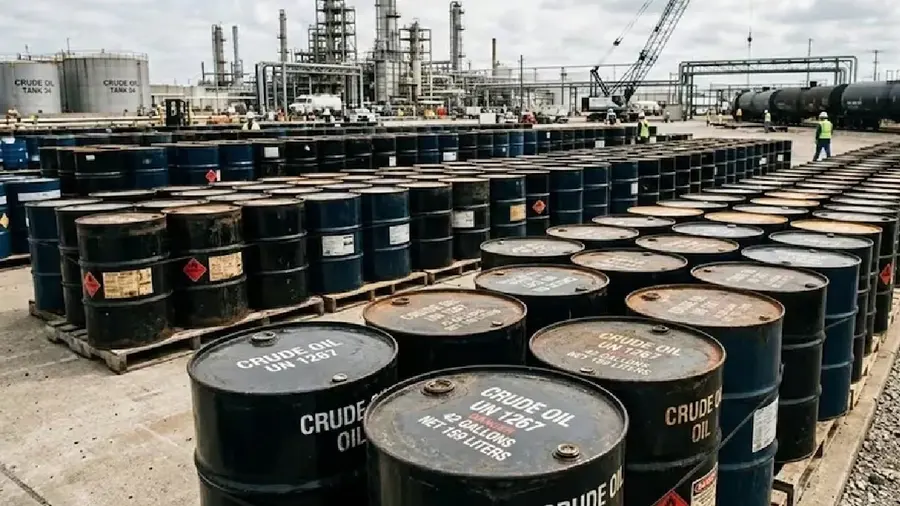
U.S. commercial crude oil inventories, excluding those in the Strategic Petroleum Reserve (SPR), decreased by 0.9 million barrels from the week ending April 3 to the week ending April 10.
That’s what the U.S. Energy Information Administration’s (EIA) latest weekly petroleum status report, which was released on April 15 and included data for the week ending April 10, highlighted.
This EIA report showed that crude oil stocks, not including the SPR, stood at 463.8 million barrels on April 10, 464.7 million barrels on April 3, and 442.9 million barrels on April 11, 2025. Crude oil in the SPR stood at 409.2 million barrels on April 10, 413.3 million barrels on April 3, and 397.0 million barrels on April 11, 2025, the report showed.
Total petroleum stocks – including crude oil, total motor gasoline, fuel ethanol, kerosene type jet fuel, distillate fuel oil, residual fuel oil, propane/propylene, and other oils – stood at 1.675 billion barrels on April 10, according to the EIA report. Total petroleum stocks were down 13.1 million barrels week on week and up 69.5 million barrels year on year, the report pointed out.
“At 463.8 million barrels, U.S. crude oil inventories are about one percent above the five-year average for this time of year,” the EIA said in its latest weekly petroleum status report.
“Total motor gasoline inventories decreased by 6.3 million barrels from last week and are one percent above the five-year average for this time of year. Both finished gasoline and blending component inventories decreased last week,” it added.
“Distillate fuel inventories decreased by 3.1 million barrels last week and are about six percent below the five-year average for this time of year. Propane/propylene inventories increased by 0.3 million barrels from last week and are 68 percent above the five-year average for this time of year,” it continued.
U.S. crude oil refinery inputs averaged 16.0 million barrels per day during the week ending April 10, according to the EIA’s report, which noted that this was 208,000 barrels per day less than the previous week’s average.
“Refineries operated at 89.6 percent of their operable capacity last week,” the EIA highlighted in the report.

“Gasoline production increased last week, averaging 9.8 million barrels per day. Distillate fuel production decreased, averaging 4.9 million barrels per day,” it added.
U.S. crude oil imports averaged 5.3 million barrels per day last week, the report stated. It outlined that this was a decrease of 1.0 million barrels per day from the previous week.
“Over the past four weeks, crude oil imports averaged about 6.1 million barrels per day, 1.3 percent less than the same four-week period last year,” the EIA said in its report.
“Total motor gasoline imports (including both finished gasoline and gasoline blending components) last week averaged 316,000 barrels per day, and distillate fuel imports averaged 118,000 barrels per day,” it added.
Total products supplied over the last four-week period averaged 20.6 million barrels per day, up by 5.6 percent from the same period last year, the EIA stated in the report.
“Over the past four weeks, motor gasoline product supplied averaged 8.8 million barrels per day, up by 3.6 percent from the same period last year,” it pointed out.
“Distillate fuel product supplied averaged 3.9 million barrels per day over the past four weeks, up by 2.2 percent from the same period last year. Jet fuel product supplied was down 0.2 percent compared with the same four-week period last year,” the EIA went on to state.
In a statement sent to Rigzone on Thursday, Naeem Aslam, Chief Investment Officer at Zaye Capital Markets, outlined that the EIA’s latest weekly petroleum status report showed “a decent U.S. crude inventory draw”.
Ole R. Hvalbye, Commodities Analyst at Skandinaviska Enskilda Banken AB (SEB), noted in a SEB report sent to Rigzone on Wednesday that U.S. crude inventories “rose by 6.1 million barrels last week according to the API [American Petroleum Institute], marking the eighth consecutive weekly build”.
“This reflects the U.S. market being relatively well-supplied compared to Asian and European markets that are being starved of Middle East barrels,” he added.
“From our platform to LinkedIn’s energy professionals – your announcements reach the entire sector’s network, not just our readers.”