Norway continues to maintain high oil and gas production levels from its continental shelf, while petroleum resources are estimated to have increased over the past year.
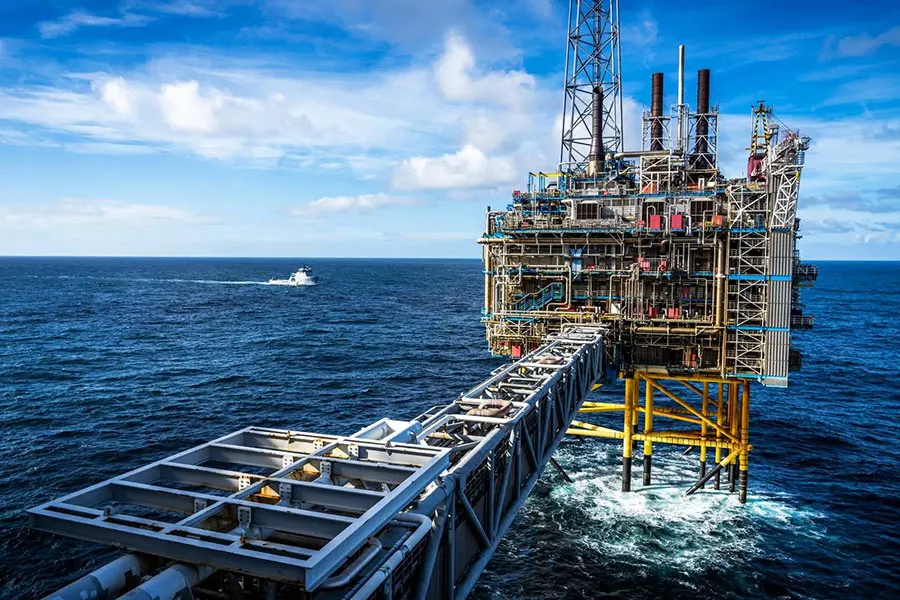
Companies operating on the Norwegian Continental Shelf (NCS) continue to make new discoveries and consider fast-tracking developments via tie-backs to existing infrastructure as Norway looks to boost its hydrocarbon production further amid the major supply shock in the Middle East.
While Norway’s oil and gas output and exports are maxed out and cannot help materially in alleviating the shocking loss of supply stuck at the Strait of Hormuz, Western Europe’s biggest oil and gas producer continues to bet on stable long-term production, to act as the most reliable supplier in testing times.
High Production, Rise in Resources
Last year, oil production on the NCS hit its highest level since 2009, the Resource Accounts 2025 report by the regulator, the Norwegian Offshore Directorate, showed.
More than half of the production is being replaced with new reserves, and the total petroleum resources on the NCS have increased, the analysis found.
Norway saw high liquids and gas production, while the reserve growth replaces 60 percent of production. Contingent resources in fields declined in 2025, but contingent resources in discoveries rose, according to the directorate.
Overall, Norway saw an increase in total petroleum resources last year.
Despite few new development plans in 2025, licensees on the fields have replaced three of five produced barrels with new reserves.
The Troll and Johan Sverdrup fields have the largest remaining reserves on the NCS, according to the regulator.
In 2025, there were a total of 91 discoveries on the NCS with the total resource estimate distributed between 53 percent liquids and 47 percent gas. The volume of discoveries has increased from 2024, thanks to high resource growth from exploration activity in 2025. Several older discoveries also have a changed status. These discoveries were previously excluded from the contingent resources because development was deemed unlikely, but they are now covered by this class and therefore contribute to the increase in total resources, the directorate said.
Even with high oil and gas production and a rise in discovery volumes, Norway still has a lot of oil and gas waiting to be discovered.
All three ocean areas of the NCS – the North Sea, the Norwegian Sea, and the Barents Sea – still hold substantial undiscovered resources, according to the regulator.
The Barents Sea has the highest resource estimates, as exploration activity here has remained low over a long period of time. The North Sea holds the fewest undiscovered resources, yet it has seen the highest level of exploration activity.
About 63 percent of Norway’s undiscovered resources are located in the Barents Sea, said the regulator. The Barents Sea North is the ocean area with the highest estimate for undiscovered liquids resources, while the Barents Sea South has the highest estimate for gas resources.
However, these are the ocean areas with the greatest uncertainty in resource estimates, which is reflected in the considerable range between the high and low estimates, the report says.
But there are also considerable undiscovered resources in the North Sea and the Norwegian Sea. Due to existing infrastructure, there is a considerable potential for value creation in these areas, even in minor discoveries. In the North Sea, liquids are expected to account for the largest share of discoveries, while there is an equal distribution between undiscovered liquids and gas in the Norwegian Sea.
The Norwegian Offshore Directorate expects undiscovered resources to make up 22 percent of the overall resources on the NCS. Sixty percent of this is in areas open for exploration. These are distributed across 29 percent in the Barents Sea, 15 percent in the Norwegian Sea, and 16 percent in the North Sea.
How Norway’s Tight Reservoirs Could Be Developed
Separately, the directorate’s latest mapping from early March showed that cooperation between the companies, cost reductions, and application of new technology can contribute to profitable production from tight reservoirs.
The NCS contains large quantities of oil and gas in so-called tight reservoirs. Many of the about 90 discoveries still awaiting a development decision are located in such tight reservoirs. However, in order to extract these resources in a profitable way, the industry will need to improve cooperation, cut costs, and apply more modern technology, the regulator noted.
Many discoveries remain undeveloped due to challenging reservoir properties and high risk. Profitability for these discoveries is also lower than for the reservoirs that have been produced so far, according to the directorate.
The regulator, which has been assigned by the Ministry of Energy to map the challenges and opportunities to develop these resources, pointed to several types of technology that can lead to increased production from tight reservoirs. These include hydraulic fracturing, slim-hole drilling, coiled tubing drilling, and controlled acid jetting (CAJ) technology.
“Several of these technologies are well-tested elsewhere around the world. They aren’t entirely new on the NCS, either, but are underused. We need more experience to improve our risk understanding and bring the costs down,” said Arne Jacobsen, Assistant Director for Technology and Subsurface at the Norwegian Offshore Directorate.
Modelling and field studies of the Victoria, Warka, Sabina, and Linnorm discoveries show that these types of technology could substantially increase the recovery rate. Many deposits with tight reservoirs were awarded in the APA 2025 tender, for example Victoria in the Norwegian Sea. Technology such as hydraulic fracturing could be very important here, according to the regulator.
New Discoveries
Over the past weeks, Equinor has made several discoveries in the North Sea and the Barents Sea, and these discoveries are now under consideration for potential fast-track development via existing infrastructure in their respective areas.
Equinor announced in early March that together with its partners it had made a commercial oil discovery in the Snorre area in the North Sea.
Preliminary estimates suggest the volumes in the discovery are between 25 and 89 million barrels of recoverable oil equivalents.
The partnership has already planned for a rapid and cost‑effective development.
“The new discovery will be tied back quickly to existing subsea facilities and produced through the Snorre A platform,” said Erik Gustav Kirkemo, senior vice president for the Southern Area in Exploration & Production Norway at Equinor.
“Near field exploration is important for extending the lifetime of fields already in operation. Since most of the infrastructure has already been paid off, these are competitive barrels.”
According to Trond Bokn, senior vice president for Project Development at Equinor,
“What is new is that we are now planning the field development prior to discovery. This makes it possible to bring new discoveries into production in just two to three years.”
Kirkemo noted that Equinor’s ambition is to maintain roughly the same production level in 2035 as in 2020. This would mean production of around 1.2 million barrels of oil and gas per day from the Norwegian continental shelf.
“About 70 percent of this will come from new wells and developments, and we plan to drill 250 exploration wells, most of them near existing fields,” Kirkemo said.
Separately, Equinor has discovered oil in the Troll area and gas and condensate in the Sleipner area, both in the North Sea. Both discoveries are considered commercial and were made in areas with well-developed infrastructure for export to Europe.
The Byrding C discovery was made five kilometres northwest of the Fram field in the Troll area and is estimated to contain 4–8 million barrels of recoverable oil.
The Frida Kahlo discovery was drilled from the Sleipner B platform. The well is located northwest of the Sleipner Vest field and is estimated to contain 5–9 million barrels of oil equivalent of gas and condensate. The well will be brought on stream as early as April, Equinor said.
Equinor has also made an oil discovery in the Polynya Tubåen prospect in Barents Sea close to the massive Johan Cstberg field, which started up production last year.
Preliminary estimates put the size of the discovery at between 14 and 24 million barrels of recoverable oil equivalent.
The licensees are considering whether they could tie the discovery back to the Johan Castberg field, the Norwegian regulator said.