ExxonMobil decom boss gives detailed walk through of the plan
A detailed explanation of how the Bass Strait will be decommissioned has emerged during a state government inquiry into decommissioning in Victoria.
On Friday, ExxonMobil’s head of decommissioning Richard Perry addressed the state government’s Legislative Council Environment and Planning Committee which is investigating the decom puzzle which needs addressing in their coastal waters.
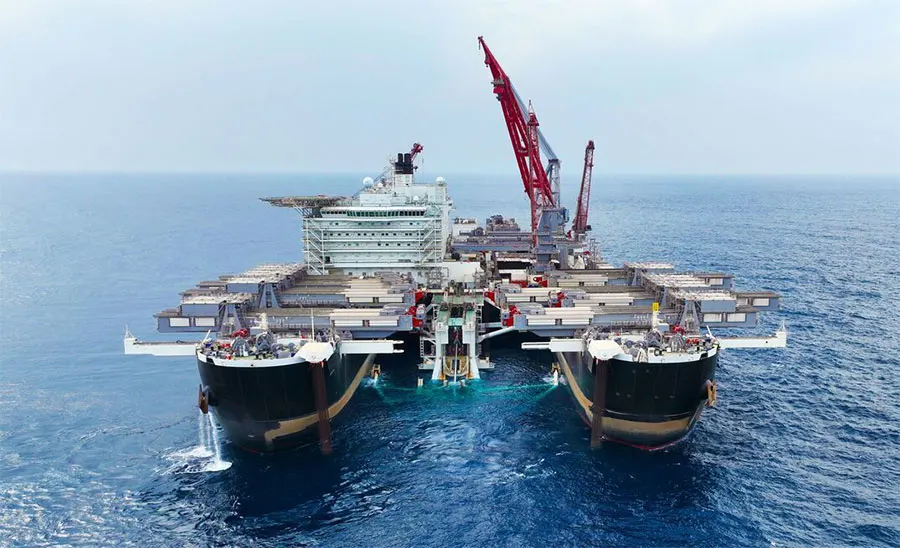
During his video-link appearance, he explained how Campaign One – the removal of 12 platforms – would proceed and the role of Allseas’, the marine contractors brought in by the ExxonMobil-Woodside joint venture, and the largest construction vessel in the world, the Pioneering Spirit.
“We’ll remove the top sides in a single lift with the bow of the vessel in the catamaran configuration. And then what we can see here is the removal of the jacket from the stern of the vessel using the lifting system – or the jacket lift system – as they call it, which is, again, specifically designed for this type of application,” he explained while showing the panel an animation of the process.
“Allseas have done numerous platform removals with this vessel. It’s been commissioned for about 15 years and has done many of these activities in the North Sea and elsewhere. This will be the first time it’s come to Australia,” he said, adding that it will only operate in Commonwealth waters.
Perry explained that the top sides above water will be removed first and then they will cut the lower section from below the sea’s surface, adding that there is still some discussion continuing as to what depth they will be cut.
“From a safety and navigation perspective, International Maritime Organization requires at least 55m of clear water – from main sea level down you can’t have any structures that are shallower than that depth. And so that is our minimum cut off depth. We’re working through what is the best location to cage one of those off to make sure we’ve got the safest execution method,” he said.
When the work happens in late 2027, once cut the 60,000 tonnes of structures will be loaded onto barges or heavy transport vessels and be brought in through Corner Inlet and into Barry Beach marine terminal (BBMT) where they will be offloaded on to the quay and taken to their set down location.
Perry highlighted the technological advances which have been made in the years since the structures were erected.
Highlighting groupings of mobile stages moving around the quayside, Perry said: “You can see there…the self propelled modular transporters. They are remote controlled, and so they will go in under each of these structures as they come in, take them over a bridge, which bridges over the existing key wall, and then take each of the structures to its designated location.
“This is a technology today that we can utilize much more precisely with how we manoeuvre these structures around the site,” he said.
Once the structures are ashore, ExxonMobil’s teams and their contractors will turn their attention to dismantling and recycling them at the BBMT, a site ExxonMobil knows very well.
“For nearly 60 years Barry Beach has served as the main supply depot for Esso to support Bass Strait offshore operations. In 2023 over 20,000 tons of supplies were delivered to our platforms across about 85 voyages. At the same time, the terminal has played a key role in supporting nearly $3b of decommissioning activity we have completed in the recent years as we prepared our offshore facilities for removal,” he said, adding that more than 10,000 tons of steel and concrete has already been brought back to Barry Beach, most of which has gone on to be recycled.
“Most of our offshore facilities were fabricated at Barry beach through the 60s, 70s and 80s and it’s great to see this location continue to be utilized for decommissioning and recycling,” he said.
In designing the decommissioning program ExxonMobil assessed a range of ports to determine which had the best capability for the project but found BBMT had “the best combination of proximity to field, sheltered transportation for the structures, lay down space available, and proximity to the required workforce in Gippsland.”
Perry also touched on the regulatory approvals needed to bring the material ashore.
“We have navigated a complex regulatory pathway to obtain all the necessary approvals from commonwealth and state regulators so that we can start preparing Barry beach to be our onshore reception centre.
“These regulatory approvals were critical to enabling the Campaign One project. With these approvals in hand, we recently commenced works to prepare Barry beach for the decommissioning work ahead,” he said.

Dismantling
While Allseas will oversee the cutting of the structures and their delivery to shore, the onshore dismantling work will be done by a Gippsland firm called CMA Contracting, which was recently responsible for the Hazelwood power station decommissioning work.
Part of the BBMT has been designated as the onshore reception centre and is where all the structures will be delivered.
Part of that site will be given over to temporary office space for the workforce as well as a water treatment facility to ensure any water draining off the site will be treated with no risk of any contaminants getting into the Ramsar wetlands nearby.
“Once we get the structures to shore, we will go through a [process] of removing all the hazardous waste before we start the full demolition process, and that’ll all be handled in compliance with all of the regulatory requirements for those hazardous wastes, such as asbestos and naturally occurring radioactive material (NORMs),” said Perry.
Once cleaned the structures will be brought to ground on to an impermeable membrane which has been installed in advance to ensure any liquids that may come out of the facilities will be captured and will go through the wastewater treatment plant.
Pipes
As well as the structures themselves the JV needs to address the many kilometres of subsea pipes.
“We send down what are called pigs in the industry – effectively like steel wool – that we run down through the pipe and scrape the inside of the pipe and send all of that through to Longford where it can be processed…Once we are ready to remove the structures, then we cut them off at the seabed and leave them full of water,” said Perry.
“It’s a network a bit like a spider web. We basically clean as a very detailed sequence of cleaning each of these pipes into a hub, and then eventually, once we’ve got all of those branches cleaned, we do clean the trunk lines back to shore. So, at the end of the day, all of the pipelines will be completely cleaned,” he added.
Recycling
When quizzed on what will happen to the steel that’s brought ashore and how it will be recycled, Perry said the company’s preference is for it to be done locally.
“We are some years away from having steel to recycle at scale, and so we’ll continue to watch that market. We’re working with the Australian Steel Institute around assessing where the capabilities lie to manage our particular steel that we’re going to have. It is very heavy walled and is quite significant – quite a lot of power will be required to manage what we will have,” he said.
Response to concerns
Perry was keen to highlight how the design of the process had been influenced and indeed amended in response to concerns raised by the local community.
An original plan for bringing the structures ashore had the jackets being laid across the barge, with their ends hanging overboard. Following concerns about “marine growth dropping off into the water,” Perry said they have adjusted their plans and have opted to use heavy transport vessels with a wider deck meaning there is no overhang.
Similarly, ExxonMobil had considered “bringing in the structures the same as they went out…skidding them in or sliding them in.” However, due to concerns raised they have changed the plan to use self-propelled modular transporters to enable a greater degree of manoeuvrability.
“Again, a more complex and probably not the lowest cost solution,” he stated.
Gold standard
Perry explained that the design concept for the yard has been influenced by how Norwegian yards operate – what he called the “gold standard.”
“We’re modelling our structure and setup for Barry beach along the same lines, including an impermeable membrane and the water treatment facilities,” he said.
Responding to concerns voiced by one of the committee’s members, Perry was reassuring.
“We strive for perfection offshore, and there has been disappointing times when we have had some incidents in the past. We thoroughly investigate those in conjunction with the regulator to ensure we learn from those and make sure they won’t happen again.
“I can confirm that we will be bringing in, as I said, world class contractors to do this work, and we will ensure this is done in the most environmentally and safe way.”
“Join the companies that smart energy professionals follow – because when you’re featured on GEN, the industry pays attention.”